
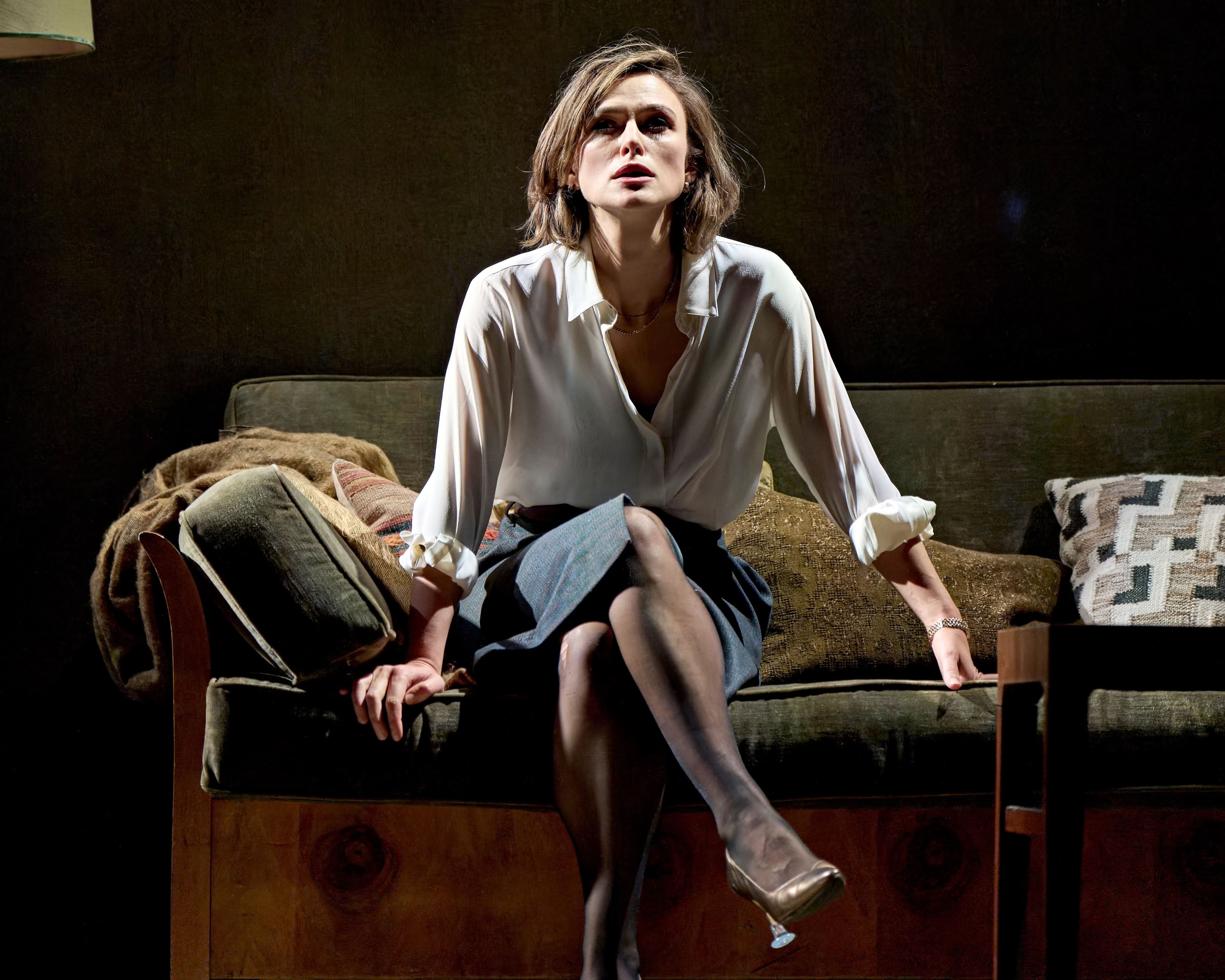
The stage production of the Oscar-winning film brings Cold War surveillance and political repression to the theatre, with striking performances and ambitious stagecraft, but struggles to recreate the original’s subtlety.
Keira Knightley has returned to the West End stage for the first time in 15 years, taking the lead in Robert Icke’s adaptation of The Lives of Others, the Oscar-winning German film about surveillance and artistic repression in 1980s East Berlin.
Set in the German Democratic Republic in 1984, the production follows playwright Georg Dreyman, played by Luke Thompson, and his actress partner Christa-Maria Sieland, portrayed by Knightley. Their lives come under scrutiny when Stasi captain Gerd Wiesler, played by Stephen Dillane, is assigned to monitor their apartment for signs of political dissent.
The story explores the corrosive effects of living under constant surveillance, as well as the moral conflict facing a state agent whose loyalty to the regime begins to weaken. While Dreyman struggles with the gap between his political beliefs and the reality of the system around him, Wiesler gradually finds himself drawn into the lives of the people he is supposed to be watching.
Dillane’s restrained performance gives the production much of its emotional weight. His largely silent portrayal of Wiesler conveys the officer’s growing uncertainty through small gestures and reactions, particularly as he listens to Dreyman playing the piano following the death of a fellow artist. Knightley brings considerable presence to the role of Christa-Maria, balancing her character’s glamour and vulnerability with the compromises she makes to survive. Thompson, meanwhile, portrays Dreyman as an increasingly troubled writer confronting the contradictions of the socialist state.
The production’s most striking achievement is its use of stage design to recreate the atmosphere of a surveillance society. Hildegard Bechtler’s set places the couple’s apartment at the centre of the action, with its rooms slowly rotating to expose every corner to the audience. Telephones, bookshelves, light switches and floorboards become potential hiding places for recording devices, while transparent screens reveal the private spaces of the home.
Lighting, projections and sound effects reinforce the sense of intrusion. At times, the stage becomes an interrogation room; at others, it resembles a camera lens closing in on its subjects. The audience is repeatedly positioned as an observer, raising questions about the relationship between watching and being watched.
Icke, known for his fast-paced reinterpretations of classic works, also keeps much of the action within the apartment, intensifying the claustrophobic atmosphere. The production runs without an interval, maintaining tension throughout its two-hour duration.
However, translating the film’s understated emotional language to the stage presents a considerable challenge. The original relied heavily on Ulrich Mühe’s subtle portrayal of Wiesler, using close-ups and silence to reveal the officer’s internal transformation. On stage, that shift is harder to communicate, and some of the production’s emotional developments risk becoming overly dramatic or insufficiently explained.
The adaptation also raises questions about certain plot details and character motivations, while its concluding explanation of the events may feel unnecessarily explicit. Although Knightley delivers a committed performance, the character of Christa-Maria is not always given enough depth to match the complexity of the story.
Despite these reservations, the production brings renewed attention to a story about the relationship between political power, artistic freedom and personal conscience. Its depiction of a state determined to monitor private lives and control cultural expression also gives the Cold War drama a contemporary resonance.
Ultimately, Icke’s The Lives of Others is at its strongest when it uses the theatrical space to make surveillance tangible. Whether it fully captures the subtlety of the film remains open to debate, but its performances and striking stagecraft make it a compelling return to a story about the cost of living without privacy.





Be First to Comment