
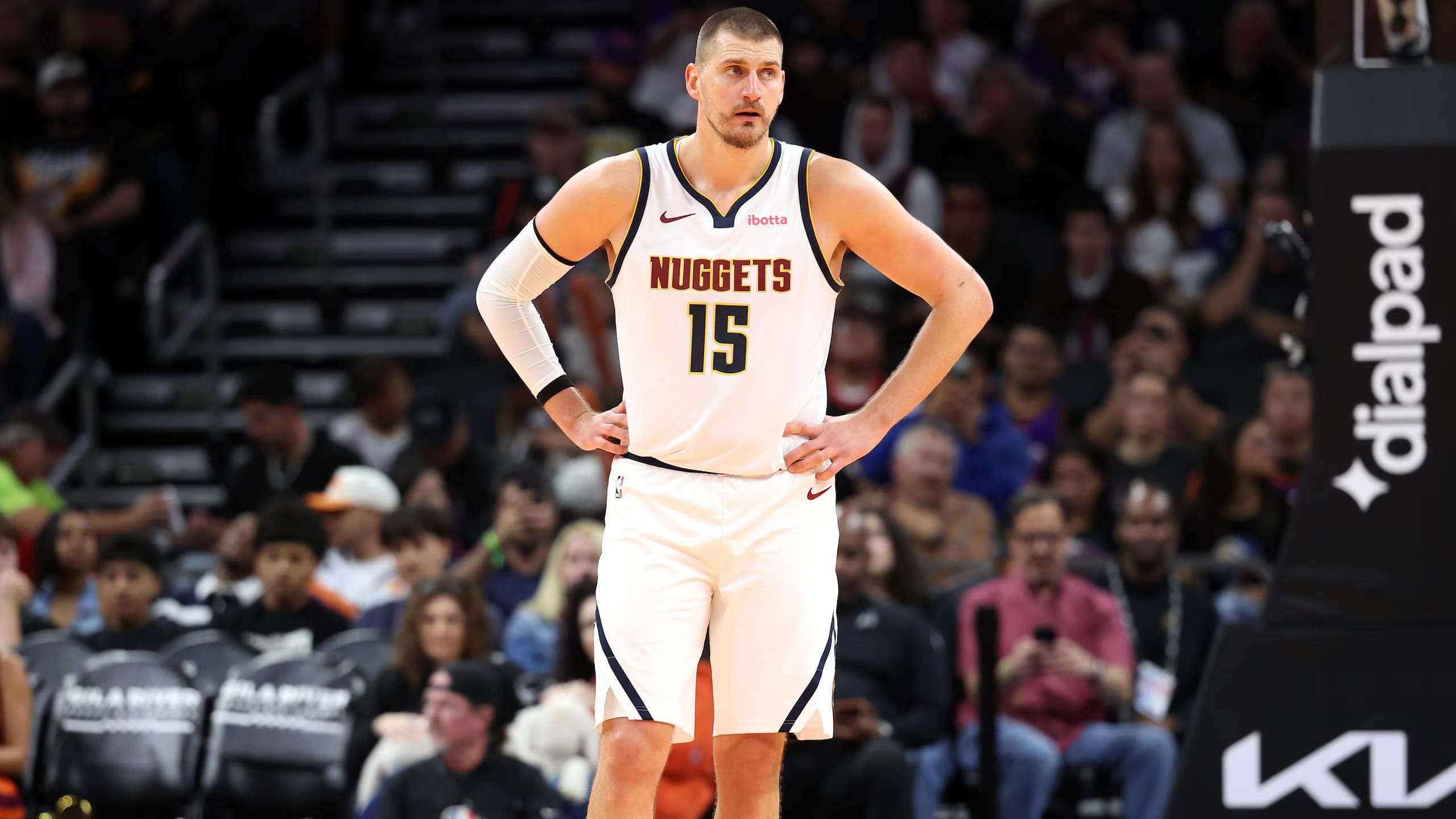
The Denver Nuggets’ early-season struggles have exposed a worrying weakness: a team built around Nikola Jokic’s consistent MVP-level performances has few answers when its star centre is not at his best.
For much of the past decade, Denver’s championship ambitions have depended on finding the right supporting cast for the Serbian star. The emergence of Jamal Murray, the 2021 acquisition of Aaron Gordon and the contributions of Christian Braun and Bruce Brown during the 2023 title run helped the Nuggets secure their first NBA championship.
Since then, however, the team has gradually lost key players without finding equally effective replacements. Now, with Jokic experiencing an unusually slow start to the 2026-27 season, those shortcomings are becoming increasingly difficult to ignore.
Through his first seven games, the 31-year-old is averaging 23.4 points, 9 rebounds and 9 assists, but his shooting efficiency has fallen considerably. He is converting 50.4% of his field-goal attempts and just 21.9% of his three-pointers, while his Player Efficiency Rating is at its lowest level since his rookie season.
Although Jokic remains among the league’s most productive players, his reduced presence around the basket and declining efficiency have affected Denver’s traditionally powerful offence. A 32-point triple-double in Wednesday’s 128-109 victory over Toronto offered some encouragement, but the Nuggets have yet to demonstrate consistent performances against stronger opponents.
Coach David Adelman remains confident that Jokic will return to his usual form, describing the current statistics as a limited sample from one of the most efficient offensive players in basketball history.
The bigger problem is the supporting cast. Gordon is still recovering from last season’s injury problems, Cameron Johnson has struggled to meet expectations and the second unit has failed to provide consistent scoring. Denver’s bench ranks among the league’s weakest, leaving too much responsibility on Jokic and Murray.
The team has also struggled to maintain its offensive identity. Denver has traditionally relied on an elite attack to compensate for defensive weaknesses, but its offence has slipped outside the league’s top 10. Its limited production in the paint and relatively low volume of three-point attempts have further exposed its lack of balance.
The situation is complicated by the franchise’s financial constraints. Major contracts for Jokic, Murray, Gordon and Braun leave little flexibility to strengthen the roster. Denver has also traded away several future first-round picks, limiting its ability to rebuild through the draft.
Jokic is expected to sign a potential five-year extension worth up to $360 million next summer. However, committing such a significant sum to a player approaching his mid-30s would make it even harder for the Nuggets to address their roster weaknesses while avoiding the NBA’s second-apron restrictions.
Despite the uncertainty, Jokic has given no indication that he wants to leave Denver. His situation could follow the example of Dirk Nowitzki, who remained with Dallas after leading the Mavericks to the 2011 championship, even though the team never won another playoff series during his career.
For now, the Nuggets’ immediate challenge is to rediscover their winning formula. Their early-season struggles suggest that even a temporary decline in Jokic’s performances could expose the limitations of a roster that has become increasingly dependent on him.
The central question for Denver is no longer simply how to build around Jokic, but whether the franchise has a plan for a future in which he cannot carry the team on his own.





Be First to Comment