
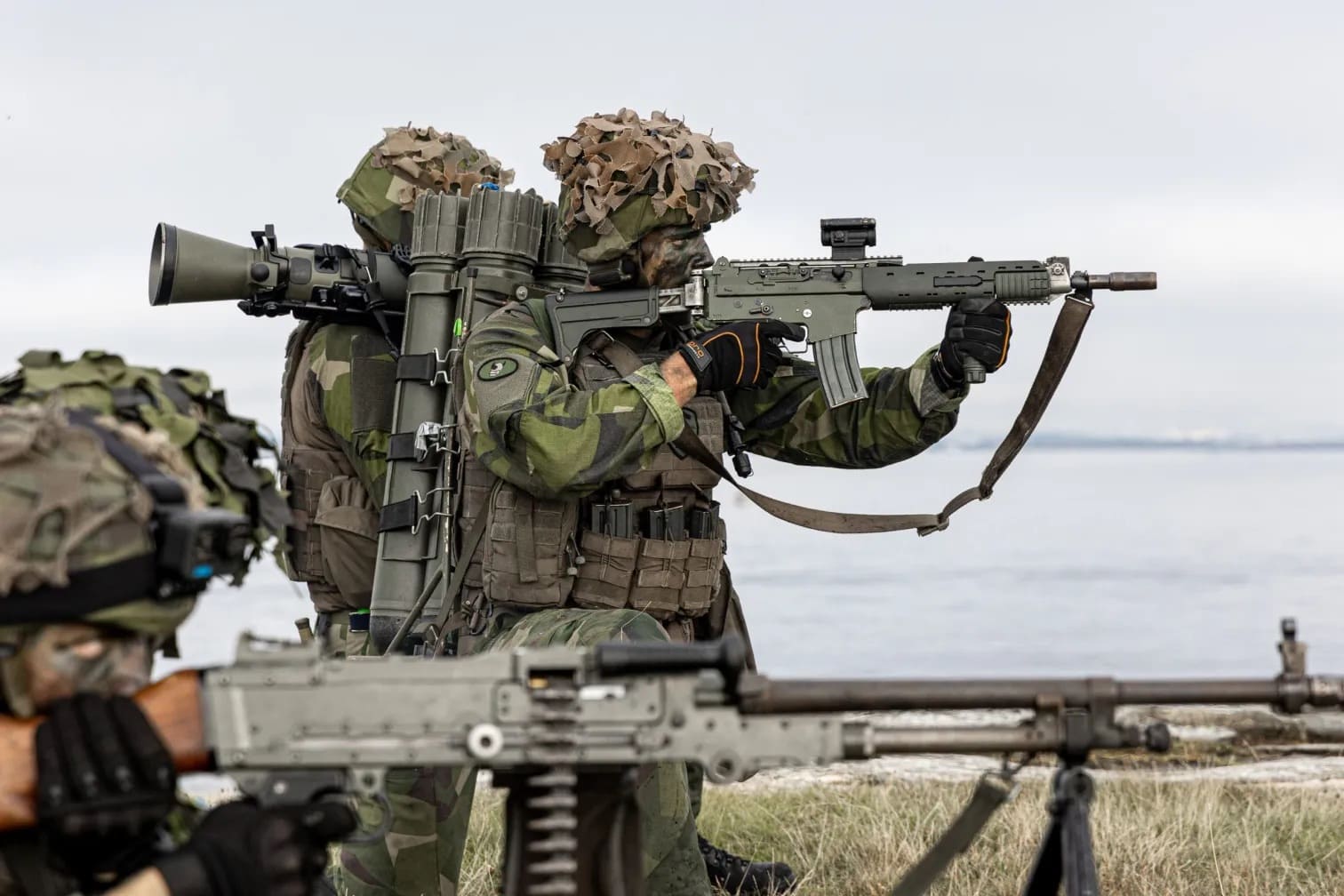
The alliance is moving from a forward presence to forward defence in Estonia, Latvia and Lithuania, aiming to prevent Russian forces from entering their territory. The First German-Netherlands Corps has been given a central role in coordinating military operations across the region.
NATO is overhauling its defence strategy on Europe’s eastern flank, with a new focus on stopping any Russian advance at the borders of the Baltic states rather than allowing territory to be occupied and attempting to reclaim it later.
The shift has gathered pace since Russia launched its full-scale invasion of Ukraine in 2022. One of its most visible examples is Estonia’s preparations around Narva, the country’s easternmost city, which lies directly across the river from Russia.
During a recent visit by senior German and Dutch military commanders, nearly 80 generals inspected newly built trenches and bunkers in the forests north of the city. Estonia is planning to construct several hundred bunkers across the country, alongside anti-tank obstacles and other fortifications.
An Estonian battalion commander told the visiting generals that the objective was clear: “We want to stop them here.”
From forward presence to forward defence
The new approach marks a significant departure from NATO’s previous plans for the Baltic region. In 2022, then Estonian Prime Minister Kaja Kallas criticised defence arrangements that could have allowed the Baltic states to be overrun before allied forces attempted to liberate them within 180 days.
At the 2023 Vilnius summit, NATO allies approved regional defence plans that shifted the alliance’s focus from “forward presence” to “forward defence”. The strategy is designed to prevent Russian forces from establishing a foothold in allied territory in the first place.
Estonia has begun moving military bases closer to the Russian border and is planning a new facility in Narva that could accommodate around 1,000 troops.
The preparations reflect lessons drawn from the war in Ukraine, where Russian occupation has brought widespread destruction and systematic abuses against civilians. Baltic officials believe that allowing territory to fall before attempting to retake it is no longer an acceptable option.
German-Dutch corps takes operational command role
The First German-Netherlands Corps, known as 1GNC, has been assigned a central role in coordinating the defence of Estonia and Latvia. NATO designated the multinational headquarters as the region’s tactical command headquarters this summer.
Its responsibilities extend beyond coordinating ground forces to include air, naval and space capabilities, logistics and efforts to disrupt Russian supply lines before troops can cross the border.
Dutch Lieutenant General Jan Swillens, commander of the Royal Netherlands Army, said Narva could be defended, but stressed that the priority must be to prevent a war from breaking out.
“The war must be won before it starts,” Swillens said, emphasising the need for effective deterrence, operational plans and the ability to deploy troops.
His German counterpart, Lieutenant General Christian Freuding, said NATO had a clear political mandate to defend every inch of allied territory. The presence of senior German and Dutch commanders in Narva, he added, was intended to demonstrate that the alliance was both willing and able to defend the city.
Article 5 remains a political decision
A response to a possible Russian incursion would involve two levels of decision-making. Estonia would determine whether its forces could immediately return fire in the event of a border violation. A decision to invoke NATO’s Article 5 collective defence clause, however, would require unanimous agreement among all 32 members of the North Atlantic Council.
Swillens recalled how NATO consultations were rapidly initiated after missiles entered Polish airspace, triggering discussions under Article 4 of the alliance treaty.
However, uncertainty remains over the political willingness of the United States to support its European allies in the event of an attack, particularly under President Donald Trump.
Narva’s Russian-speaking population has sometimes featured in scenarios involving a limited Russian incursion into NATO territory. Estonian military officials dismiss claims that the community could be used to destabilise the country, arguing that many residents hold Estonian citizenship and serve in its armed forces.
Drones and electronic warfare shape future defences
The military delegation’s visit to Lithuania included demonstrations of technologies designed to stop an invading force during the early stages of an attack. Near the border with Belarus, commanders were shown how sensors, aerial drones, interceptor systems and unmanned ground vehicles could be deployed to detect and engage hostile forces while keeping allied troops out of direct fire.
Freuding acknowledged that Germany’s armed forces still have significant capability gaps, particularly in electronic warfare, which involves protecting friendly communications while disrupting those of an adversary.
Both commanders stressed that closer cooperation with defence companies and the wider industrial sector would be essential. They want production capacity that can be rapidly expanded in a major conflict, making use of the latest technologies.
The visit concluded in Lithuania, where German and Dutch troops are also deployed as part of NATO’s multinational battlegroups. Swillens said their presence sent a strategic message that the defence of the Baltic states was a commitment shared by the entire alliance.
He also warned that a ceasefire in Ukraine would not necessarily end the Russian threat, even if it took one, two or five years for Moscow to resume its military ambitions.
“We are in an entirely new strategic era,” he said.





Be First to Comment