
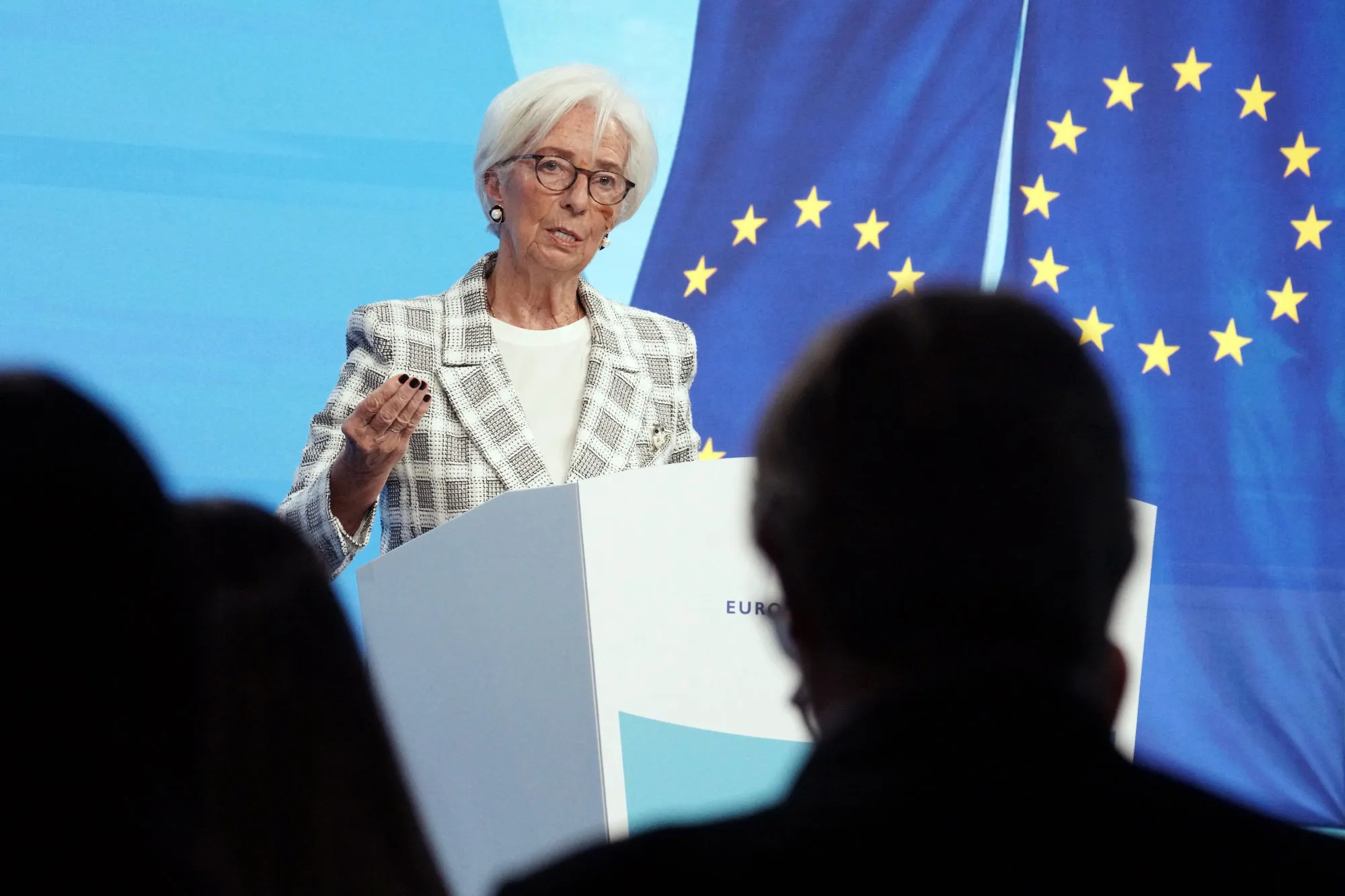
European Central Bank President Christine Lagarde said Portugal, Italy, Greece and Spain, once grouped under the PIGS label as the eurozone’s weakest economies, are now among the region’s strongest performers.
Speaking to around 600 students at an event organised by the Observatory for Independent Thinking in Milan, Lagarde also discussed the ECB’s interest-rate outlook, rising inflation and the importance of financial education.
ECB to reassess rate outlook in December
Lagarde said the ECB had considered another interest-rate increase at its latest monetary policy meeting but decided to wait for further economic data before taking action.
The central bank will review its projections in December to determine whether a rate hike is needed to bring inflation back towards its target, she said.
Eurozone inflation has reached 4%, while Italy’s rate has climbed above 5%. Lagarde attributed much of the recent increase to energy prices, which have risen sharply amid the conflict in the Middle East.
Higher energy costs are feeding into prices across the economy and weighing on growth, she said, adding that the impact could persist for some time. However, she stressed that economic conditions were changing rapidly.
Rejecting the traditional distinction between monetary policy “hawks” and “doves”, Lagarde described herself as an “owl”, emphasising a pragmatic approach based on economic data rather than ideology.
“I have not become a dove or a hawk,” she said, noting that policymakers on both sides had shifted their positions over the past seven years.
Southern Europe moves up the rankings
Responding to questions about whether a single monetary policy can work across 21 eurozone countries, Lagarde asked students to recall the PIGS label, once used to describe Portugal, Italy, Greece and Spain as the bloc’s weakest economies.
“Look at them today: they are at the top of the rankings,” she said, also pointing to Ireland and Cyprus as countries now performing strongly.
Although these economies could achieve faster growth and reduce their public debt further, the overall trend was moving in the right direction, she added.
Financial education as a component of freedom
Lagarde also praised the Young Factor initiative, which aims to improve economic and financial literacy among students. The programme is expanding beyond Italy, with activities under way or being developed in Germany, Spain, France, the Netherlands and Portugal.
She described financial literacy as “an essential component of freedom”, particularly for women, and welcomed efforts to make economic knowledge more accessible to younger generations.
Asked about her decision to leave the ECB nine months before the end of her term, Lagarde said she wanted greater independence to express her views on issues beyond monetary policy and take part in wider public debates.




Be First to Comment