
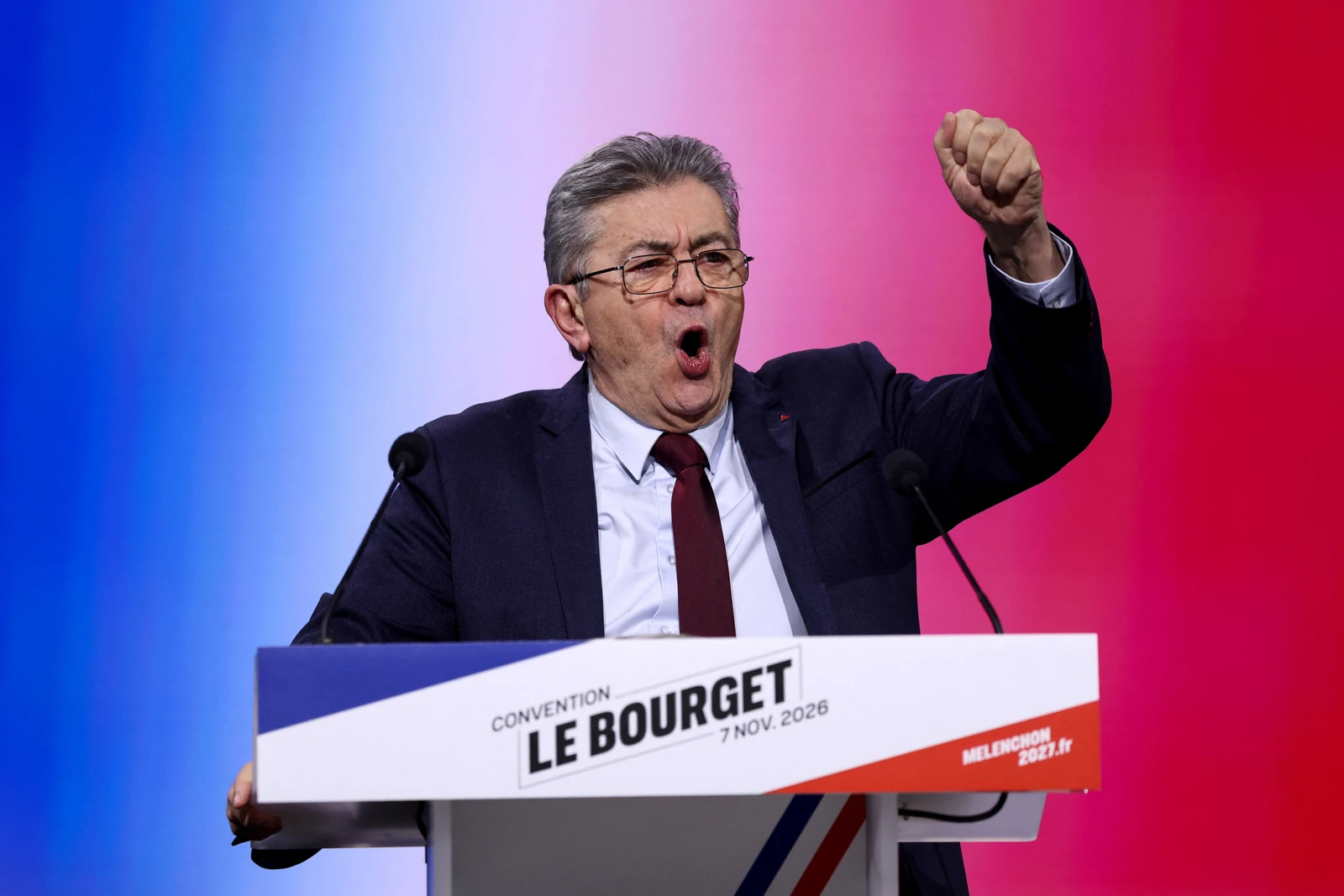
Growing public discontent, economic uncertainty and political deadlock are creating an opportunity for far-left leader Jean-Luc Mélenchon to emerge as a serious contender in France’s 2027 presidential election. His campaign is gaining momentum despite widespread opposition to his political positions and economic proposals.
Mélenchon, 75, and his France Unbowed (LFI) movement have increasingly attracted voters frustrated by rising living costs, widening wealth inequality and President Emmanuel Macron’s declining political influence. After spending much of the past two decades on the fringes of mainstream politics, the veteran left-wing politician is now seen as a potential finalist in the presidential runoff against far-right leader Marine Le Pen.
Recent polls put Mélenchon at between 17% and 18.5%, still behind Le Pen, whose support stands at 31%-33%. However, his latest gains have strengthened his position in the race to reach the second round, scheduled for May 2, 2027. A September survey also found that nearly three-quarters of respondents would not consider voting for him.
His growing appeal comes as France faces mounting financial and political pressures. Weak economic growth, a widening budget deficit and uncertainty over public finances have unsettled investors. French bond yields surged in September and October, with the spread over German government bonds reaching 178 basis points on October 22, more than doubling in seven weeks.
Mélenchon has responded to concerns over France’s financial stability with proposals for higher public spending, heavier taxation on the wealthy and the cancellation of part of the country’s sovereign debt. His programme includes taxing inheritances exceeding €12 million and cancelling the portion of French government debt held by the European Central Bank, representing around 20% of the total. The ECB considers such a move illegal.
At a rally in Clermont-Ferrand last month, Mélenchon dismissed calls to reassure financial markets, arguing that investment funds and financial institutions were driving speculation against France. His rallies have attracted thousands of supporters, with around 10,000 people attending the Clermont-Ferrand event and another 2,000 unable to enter the venue.
Supporters cite his commitments to expanding social welfare, reducing inequality and defending migrants as reasons for backing his movement. However, his leadership style and political record have also generated controversy, including accusations of intolerance towards internal dissent and criticism over his handling of allegations of domestic violence involving an LFI lawmaker. Mélenchon has also rejected accusations of antisemitism.
A former member of the Socialist Party, Mélenchon rose through its ranks in the 1980s and became France’s youngest senator in 1986. He left the party in 2008, accusing it of moving too close to business interests, and later founded France Unbowed in 2016.
Former allies say his leadership has become increasingly centralised, limiting prospects for a broader left-wing coalition. Nevertheless, LFI is betting that voters opposed to Le Pen could rally behind Mélenchon in the second round, even if they disagree with his economic programme.
Reaching the runoff would already represent a historic breakthrough for the far-left leader. Even if he fails to win the presidency, political analysts say the campaign could strengthen LFI’s position as France’s main opposition force.





Be First to Comment