
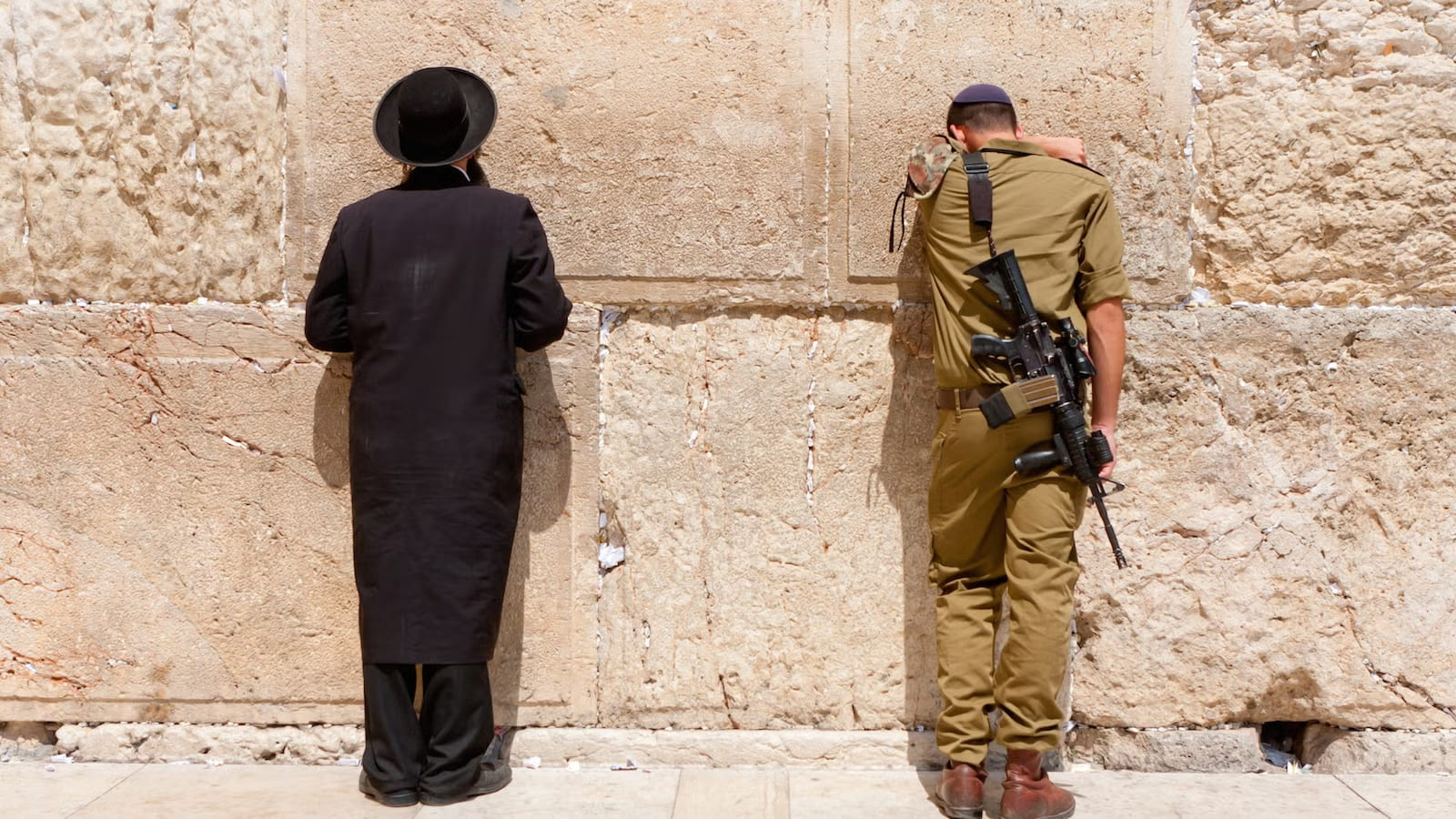
As Gadi Eisenkot seeks to bring them into his governing coalition, Israel’s Haredi parties face pressure over military service, women’s rights and their relationship with secular politics.
“Under no circumstances will we enlist.” Yitzhak Goldknopf, an Israeli parliamentarian, enjoys singing and dancing. But Israel’s national anthem, Hatikvah, is not among his favourites. Instead, the ultra-Orthodox politician has been seen enthusiastically singing along to the music of Naturei Karta, a group whose songs celebrate military refusal and the eventual end of the State of Israel.
A year ago, despite being 75 and having previously served as a government minister, Goldknopf was filmed dancing to “Lo Nitgayesh Be’shum Ofen” (“We will never enlist”), a song by an Haredi musical group that has since become a slogan at anti-Zionist demonstrations.
Can a member of parliament openly encourage refusal to serve in the military? Goldknopf evidently recognised the political risks and apologised before seeking re-election to the Knesset. But he has yet to show much enthusiasm for Israel’s national anthem. As for the controversial footage, he offered a familiar defence: he was attending a family wedding and did not want to offend the newlyweds.
The challenge facing Israel’s ultra-Orthodox parties, currently being courted to join a new governing majority led by Gadi Eisenkot, is often framed as their difficulty in joining a government that is largely secular, even atheist. But the question can also be reversed: how willing are secular Israelis to accept the demands that the country’s 11 Haredi lawmakers would bring into the coalition?
Goldknopf’s performance is only one example. He has been instrumental in pushing through many of the restrictions associated with the Jewish Sabbath, including supermarket closures and a ban on flights by national carrier El Al. His political allies have made equally controversial proposals.
Yitzhak Pindrus, a fellow party member born in 1971, has repeatedly targeted Women of the Wall, a Jewish group campaigning for women’s equal rights to pray at the Western Wall. He has suggested that its members should be kicked. His colleague Meir Porush, 71, a parliamentarian for three decades and former deputy education minister, went even further, suggesting that the women should be fed to dogs.
During Benjamin Netanyahu’s governments, some of the most extraordinary proposals have not only been discussed but have also made their way into legislation. The prospect of easing military service requirements and restoring exemptions for religious students is not the only concern for more moderate Israelis.
Pindrus, a former mayor, has also called for rapists to be shot at close range. He has advocated banning Pride marches, arguing that the decline of traditional relationships represents a greater threat than ISIS, Hamas and Hezbollah combined.
Not all ultra-Orthodox politicians share this approach. Some have tried to avoid becoming caricatures of religious extremism. Haim Biton, 48, who oversees political strategy and previously served as education minister, is one example. Another is Michael Malkieli, who entered the Knesset at 33 and later became minister of religious services under Netanyahu. So far, he has largely avoided the headline-grabbing proposals that risk reinforcing the perception of Haredi communities as political outsiders.
Another emerging figure is 41-year-old entrepreneur Yehuda Leib Weisfish, who is active in social initiatives. Fifteen years ago, while rabbis were still debating the supposedly demonic potential of the internet and whether touchscreen devices could be used on the Sabbath, Weisfish took a different approach by opening the first internet café for religious customers in Modi’in.
The term “ultra-Orthodox” also conceals a complex political landscape. Lithuanian, Hasidic and Sephardic communities have different traditions, priorities and political positions, reflected in two main parties and several internal factions.
United Torah Judaism (UTJ), which holds seven Knesset seats, primarily represents European Ashkenazi Jews. For 34 years, it has been organised around two factions that often disagree on political strategy, particularly their relationship with Netanyahu’s right-wing camp.
One faction, Agudat Yisrael, represents Hasidic Jews, who tend to place greater emphasis on mystical traditions and distinctive religious dress, including black clothing and large hats. It is led by Goldknopf.
The other, Degel HaTorah, represents the Lithuanian ultra-Orthodox community and is particularly committed to preserving Israel’s religious character. Its leader, 61-year-old Yaakov Asher, has been a member of parliament for 13 years. Although he served in the Israel Defense Forces when he was younger, he now argues that students at religious institutions should not be forced to follow the same path.
The second major ultra-Orthodox party is Shas, which represents Sephardic and Mizrahi Jews, whose communities trace their origins to the Middle East and North Africa. Founded in 1984 by Rabbi Ovadia Yosef, the party emerged partly in response to the political dominance of Ashkenazi Jews. Its supporters include many Jews of Moroccan descent, a background it shares with Eisenkot.
Shas’s influence was demonstrated by the enormous crowds attending the funeral of its founding rabbi in 2013. Its political standing, however, has weakened considerably, as reflected in its most recent electoral defeat, which cut its representation in half.
While UTJ has pledged support for Eisenkot’s prospective government, Shas has yet to make a final decision. The party is more uncompromising in its demands for military exemptions, although its political positioning is more flexible. In the past, it has even entered into an alliance with the Labour left.
Despite their differences, the two parties share several priorities: securing maximum benefits while assuming minimum obligations. Their demands range from tax exemptions for yeshivas, or religious schools, to separate tram services for men and women, restrictions on Sabbath activities and changes to military conscription laws.
Their strategies, however, are not identical. UTJ argues that Netanyahu promised to protect religious students from military service but failed to deliver, making Eisenkot worth approaching. Shas, by contrast, is reluctant to sit alongside left-wing leaders and liberal Zionists.
Bringing the different factions together will be difficult, particularly given the range of competing positions within the ultra-Orthodox political landscape. Among its more controversial figures is Hasidic politician Eliakim Stark, who has compared the lives of Haredi Jews in Israel to the persecution suffered during the Holocaust.
He has argued that it is better to be a terrorist who kills entire families, whose wife then retains access to housing, childcare and social security, than to be an ultra-Orthodox Jew in Israel. At the other end of the political spectrum stands Moroccan-born Aryeh Deri, the Shas leader who has served prison time for corruption and fraud.
Then there is Shas parliamentary leader Yinon Azulai, who blamed Reform Jews for an earthquake, describing it as divine punishment. He was particularly angered by their demands for new prayer spaces for women at the Western Wall.
As coalition negotiations continue, the Israeli left is pressing Eisenkot to give greater consideration to LGBTQ+ communities. Azulai, meanwhile, may well choose to pretend he has not heard the request.




Be First to Comment