

Swedish furniture giant IKEA is going through a difficult period as sales and profitability decline. The company is seeking to reconnect with customers and regain its growth momentum by opening smaller stores and cutting prices.
Decorations made from IKEA’s familiar yellow and blue shopping bags are almost always a sign that an IKEA store is nearby. On a morning in late June, the same scene greeted visitors outside the Westpark shopping center in Ingolstadt, Germany. Dozens of people waited outside the glass-fronted, single-story building despite the hot weather, while the welcoming team inside made its final preparations for the opening.
Peter Jelkeby, CEO of IKEA Germany, took his place at the entrance in a yellow-striped shirt. Employees formed an applause tunnel, waving Swedish flags in their hands. After Store Manager Michael Vortkamp called out, “We want to hear you now,” he took Jelkeby’s hand and started a “La Ola” chant.
Two employees wearing flower crowns cut the blue-and-yellow opening ribbon, sending golden confetti into the air. The doors opened and customers streamed inside as employees welcomed them with applause and cheers. Jelkeby watched the scene with a satisfied smile.
The Ingolstadt store is the first of its kind for IKEA in Germany. More importantly, its success could prove crucial to the furniture giant’s future.
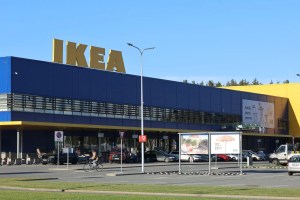
The new store is a far cry from IKEA’s enormous dark-blue stores on the outskirts of cities. While conventional stores cover around 35,000 square meters, the Ingolstadt branch is not even one-tenth that size. Instead of around 10,000 products, it offers only 2,700.
With the new store concept, IKEA wants to get even closer to its customers. Smaller stores are already operating in city centers in the United Kingdom, France, Poland and the United States. Store Manager Vortkamp sums up the strategy simply: “Someone who only needs napkins isn’t going to drive 70 kilometers to get to IKEA.” But this is precisely where the problem facing the company becomes apparent: IKEA now needs customers looking to buy just a few small household items more than ever.
The company, which designs, manufactures and sells its own products, enjoyed decades of record-breaking growth. Its huge out-of-town stores, with their Billy bookcases, Köttbullar meatballs and children’s play areas, attracted customers from around the world and turned IKEA into the world’s largest furniture retailer. These stores were essentially money-making machines.
Today, however, the furniture industry is contracting in important markets such as Germany. As consumers cut spending amid crises, wars and high inflation, rising raw material costs are also putting pressure on the industry. IKEA’s revenue has declined for two consecutive years, while its costs have been rising faster than its income.
These developments are challenging the formula for success established by company founder Ingvar Kamprad in 1943. Kamprad’s goal was to produce quality furniture at affordable prices that everyone could buy. The company calls this concept “democratic design.” In Kamprad’s words, what mattered was creating a “real difference in price that people can actually feel.” But IKEA is now struggling to offer lower prices than its competitors on many products.
For a company accustomed to years of success, this represents a major turning point. To grow again, IKEA first has to get smaller.
Unease in employee forums
Although the atmosphere at the Ingolstadt opening was cheerful, morale is not equally high at the Swedish company, where employees greet one another with a friendly “Hej.” Discontent with the sweeping cost-cutting program introduced by management is increasingly being voiced on internal employee forums.
Employees complain about inefficiencies and growing pressure to cut costs. One employee says a significant portion of the costs stems from more than 100 product teams working separately on the same problems. Another longtime employee expressed frustration by saying, “This is no longer my IKEA.” The employee, who said they had been with the company for around 36 years, argued that everything was now being made cheaper and that quality was no longer receiving enough attention. Another employee commented, “Since Ingvar’s death, the company’s values have remained only on the walls.”
IKEA rejects these criticisms. In a statement, the company said it was undergoing a restructuring process to improve efficiency, reduce duplicated work and clarify responsibilities, adding that its corporate values remained at the heart of the transformation.
Since the end of April, senior management has been preparing employees for a more difficult period. According to internal analyses obtained by Der Spiegel, IKEA aims to cut both product prices and costs by between 15% and 20% over the next five years. The company also plans to increase revenue, which currently stands at around €45 billion, by €10 billion. It is targeting at least 5% growth in the next financial year alone and plans to achieve this by attracting 100 million new customers. Management is also no longer completely ruling out selling through online platforms such as Amazon, which it has traditionally regarded as a major competitor.
On May 18, IKEA executive Jakub Jankowski addressed employees in Älmhult, Sweden. According to footage shared with Der Spiegel by attendees, Jankowski appeared on stage wearing a black T-shirt, black trousers and black shoes, giving the impression of delivering a eulogy. Known to employees as “Kuba,” Jankowski has headed Inter IKEA, the division responsible for the IKEA concept, brand rights, product development, design and manufacturing, since the beginning of the year. Profit in this division, regarded as the backbone of the company, fell 32% in the last financial year.
In a somber tone, Jankowski announced that up to 865 employees would be laid off worldwide. A deep silence fell over the room.
Jankowski also used his daughter as an example in his speech. He explained that his 20-year-old daughter, who had moved to the city of Lund near Malmö, buys her furniture online, making her a typical member of Generation Z.
“My daughter has many options, and IKEA isn’t always her choice. That hurts,” Jankowski said, recounting that when he asked her why, she replied, “You’re too expensive for some products.” He said her friends shared the same view and concluded: “Thousands of people are making the same decision.” IKEA therefore needs to offer “much more accessible prices,” he said.
The painful realities facing IKEA
At the same meeting, Jankowski presented employees with a presentation titled “10 painful truths” about IKEA’s current situation. It listed a sharp slowdown in growth, stronger performance by competitors, problems with the company’s international expansion strategy and excessive dependence on the European market among its core challenges. It also noted that the product range was insufficiently developed in certain categories, such as beds.
According to the presentation, IKEA needs to grow by between 5% and 10% every year for its current business model to remain sustainable. Although its global revenue has quadrupled since the early 2000s, the company generated €3 billion less revenue in its latest financial year than it did in 2023.
The figures indicate that IKEA’s brightest days may be behind it. In the six years through 2025, the company grew by an average of only 2%, compared with roughly 6% in the preceding period. And products were sold at lower prices during those earlier years than they are today.
For years, IKEA fueled its growth through international expansion. Today, however, its operations in the United States have almost ground to a halt, while in Asia, where it once recorded double-digit growth, sales have recently increased by only around 1%.
Jankowski asks employees: “Our competitors are growing. So why aren’t we?”
The answer may lie in the company’s products.
The Billy bookcase, once praised for its real-wood veneer, is now made with a thin veneer foil. In some places, metal fittings have been replaced with plastic. In 2014, when IKEA changed the name of its Expedit shelving system, known for its square compartments, to Kallax, it also made the shelf panels thinner. This made the product lighter and reduced the amount of wood used. Critics argue, however, that it also resulted in a decline in quality standards.
IKEA disagrees with this criticism. The company says the Kallax shelving system has been improved in terms of design, material use and weight while retaining its durability. It says the high-quality paper foil used on Billy bookcases allows wood to be used more efficiently while keeping the product affordable. A new click-in assembly system also makes the bookcase easier to assemble and disassemble than before.
IKEA has moved away from its “affordable furniture” promise
In reality, however, IKEA has gradually moved away from its long-standing promise of affordable furniture. For example, the Brimnes bed frame with drawers, measuring 140 by 200 centimeters, sold for €149 in 2021. Today, it costs €199. IKEA’s classic Malm desk, meanwhile, could be purchased five years ago for €99 for the 140-centimeter model; today, the same product costs €179. IKEA recently announced that it would largely discontinue the Malm range, which has been sold for 24 years.
Competitors are offering lower prices
IKEA’s pricing policy is also attracting growing criticism from customers. It no longer seems enough to lure shoppers with €2 hot dogs.
Several months ago, a Reddit user asked, “When did IKEA get so expensive?” The user said they wanted to renovate their bathroom and, after selecting a cabinet, a mirrored cabinet and a vanity unit, found that “suddenly almost €1,000 was gone.” Many users agreed with the complaint, saying that they used to be able to buy furniture from IKEA without thinking twice precisely because it was inexpensive. Danish competitor Jysk was frequently mentioned as an alternative.
Jysk has become one of the competitors closely watched by IKEA executives. Alongside online platforms such as Amazon, the rapidly expanding Danish company is bringing Scandinavian living to customers through smaller stores in city centers. Its home decor and home textiles categories are attracting customers, giving Jysk strength in precisely the areas where IKEA is losing sales. Despite criticism over quality, Jysk continues to increase both its revenue and profits thanks to its competitive prices.
According to IKEA’s internal analyses, 32% of its products were more expensive than those of its competitors in December. The figure was 36% on Amazon and as high as 55% at Jysk.
Management searches for a solution
So what is the solution?
The company’s management does not yet have a clear answer. In Switzerland, IKEA recently tested making discounted prices for IKEA Family members more prominent on price tags while displaying regular prices in smaller print. Following criticism from consumer rights advocates, however, the company was forced to change the price labels on 15,000 products in April.
On June 12, Inter IKEA CEO Jakub Jankowski met with employees again and said that reducing costs by 10% was a firm target. However, he acknowledged that the company did not yet know how it would achieve “the next 10% reduction,” stressing that it was nevertheless unavoidable. According to company data, all expenses—including materials, production, restocking shelves and logistics—have risen by around 32% since 2020.
As a result, IKEA has embarked on a sweeping restructuring process. Its product development center in Warsaw has been closed. Its purchasing office in Dortmund is being downsized. In the same city, Ingka, IKEA’s largest retail company, has decided to shut down its information technology division. Around 350 employees are expected to be affected by these decisions. In Rostock, meanwhile, Ingka is closing its customer service center, which employs 279 people.
A return to the old quality standards?
At the same time, the company aims to expand its online sales channel, which accounts for 28% of its revenue. IKEA invested too little in e-commerce for many years, while high delivery fees also discouraged many customers. Remaining faithful to founder Ingvar Kamprad’s philosophy, the company preferred to lead customers through long store routes, taking them past displays ranging from kitchens to children’s rooms and encouraging them to add another pillow, candle or cactus to their shopping carts.
Today, however, the company’s old way of doing business is also being questioned internally. According to Jankowski, IKEA is still operating according to habits from the past: instead of testing new products in selected markets before rolling them out more broadly, the company launches them worldwide at the same time, slowing the process down. There is also debate over whether every store needs to carry every product. In North America, for example, only 10% of customers buy the Pax wardrobe, yet the company keeps it in stock at all of its stores.
According to IKEA management, however, the key issue is rebuilding the perception of quality.
Jankowski, describing his childhood in Poland, said his mother, despite having a low income, bought an IKEA bed for her children instead of choosing a cheaper alternative. He recalled that he and his sibling repeatedly jumped on the bed without being able to break it, emphasizing that his mother got value for her money.
“It was worth the money,” Jankowski said, arguing that IKEA needs to develop products that once again give consumers that same sense of confidence.




Be First to Comment